It’s a deceptively simple question that cuts through all the noise: Where do I see myself in five years? Yet this question has the power to expose every fear, ambition, and contradiction we carry within us.
The Stuck Phase
There’s only one wall between you and the life you want to live: Mindset. “One step a day” sounds easy, doesn’t it? It’s not.
I’ve been feeling stuck lately—trapped in a phase where growth feels elusive. As a software developer at a relatively small company of 100-150 people, I get to interact with almost everyone, learning from different departments and understanding the challenges each team faces. It’s genuinely exciting and educational.
But here’s the problem: I’m not growing within my own team as much as I’d hoped. This realization started a cascade of questions that paralyzed me more than motivated me. Am I in the right place? Should I be doing something different? Instead of taking action, I found myself trapped in analysis paralysis.
The Easy Escape (That Wasn’t So Easy)
Faced with this discomfort, I did what many of us do—I looked for an escape route that felt productive. A master’s degree seemed like the perfect solution, a way to buy myself time while appearing to move forward. But even this “easy” solution spawned more questions: MBA or a technical master’s?
That’s when I reached out to my friend Aditya, who had left his job to pursue higher education. Instead of giving me a simple answer, he did something far more valuable—he pulled at the strings of my reasoning, exposing that this decision wasn’t really about a degree. It was about life itself.
Thanks to that conversation, I realized my “easy solution” was actually another iceberg.
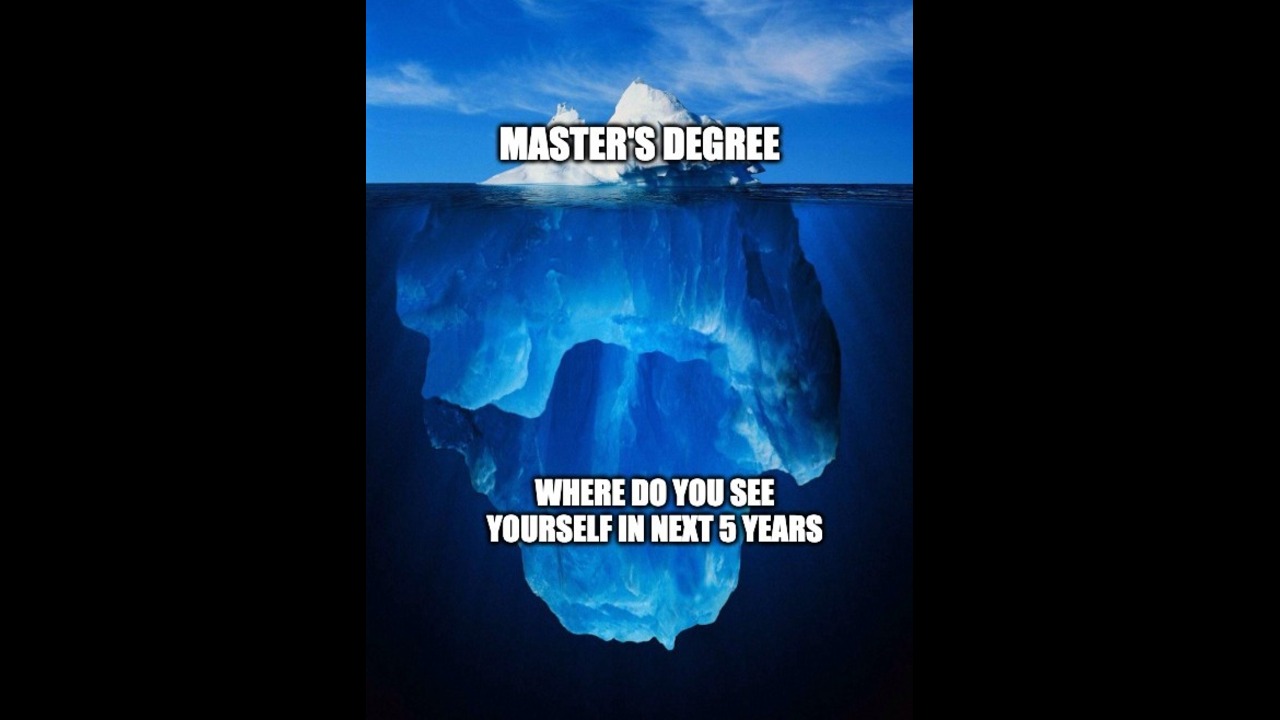
Current Reality
Where am I today, and what am I grateful for? What’s frustrating or limiting about it?
I’ve already answered this comprehensively in The dream vs The cover, but here’s the essence: I’m grateful for an incredible year as a Software Development Engineer at a fast-paced company where I’ve learned more than I could have imagined. The exposure to multiple tech stacks, real-world problem-solving, and production experience has been invaluable.
But this growth came at a cost. I’ve sacrificed personal time, relationships, and my own well-being. The most frustrating pattern is my tendency to start things with consistency—MMA, LeetCode, GitHub contributions—only to abandon them when life demands I redirect attention elsewhere. I’m caught between my ambitious dreams and what I call “the cover”—my comfort zone that’s made me more risk-averse when I should be embracing calculated risks at 23.
This internal tension between the dream and the cover is exactly why this five-year question matters so much.
The Vision: Five Years From Now
So here’s my answer: In five years, I see myself as either a tech architect or entrepreneur, depending on the path I choose, with a strong public presence, financial independence, and the physical discipline to back it all up. But beyond these labels, I want to become someone who lives deliberately, learns constantly, and uplifts others.
Path One: The Technical Leader
Let me start with what I know I’m good at—programming. I’m competent at my current level, but the real question isn’t about my current skills. It’s whether I’ll still love this work as it evolves, and whether I’ve truly explored other options before committing to this path.
What I love about programming goes beyond the code itself. I’m drawn to problem-solving, learning new technologies, collaborating with teams, and seeing the tangible impact of my work. There’s something deeply satisfying about the process of creation—taking an idea and making it real.
But here’s what keeps me up at night: What if there’s something else I’d be even better at? The fear of losing financial stability or starting over is real, but I’m 23. If there’s ever a time to take calculated risks, it’s now. Even if I explore other options, my technical experience won’t be wasted—it’ll always be an asset.
The golden handcuffs are real though. I’m earning well for my age, and the thought of potentially losing that income is terrifying. But I’ve learned that you can usually come back to tech if other ventures don’t work out.
If I stay on the technical path, I envision myself as a software architect, designing distributed, scalable systems that impact millions of users. I want to be the person who sees the big picture and guides teams toward elegant solutions.
If I pursue an MBA or management studies, I see myself as an entrepreneur. My technical background would be my secret weapon—I’d understand both the technology and the business, spotting opportunities others might miss while building the connections needed to execute on them.
The Social Advantage
Here’s something that sets me apart from the typical developer stereotype: I’m genuinely social. I love conversations, connecting with strangers, and I can present myself well when it matters. I’m not the tech nerd who lives in isolation—I thrive on human interaction.
This social dimension isn’t separate from my career goals; it’s integral to them. Whether I become a tech architect or entrepreneur, my ability to communicate, build relationships, and understand people will be my competitive advantage. I want to leverage this to build meaningful connections and expand my network.
In five years, I don’t just want to be good at what I do—I want to be a recognized face in my field. Someone people know, trust, and turn to. That excites me more than any technical achievement alone ever could.
Building Financial Freedom
I’ll be honest: my financial knowledge is decent but nowhere near where it needs to be. Eight months ago, I started investing and have seen solid returns in this volatile market. But I’m smart enough to know that beginner’s luck isn’t a strategy.
What I need are mentors—people who’ve navigated multiple market cycles, who understand the psychology of investing, and who can teach me to avoid the costly mistakes that wipe out portfolios. I want to connect with investors who can show me how they think, how they analyze opportunities, and how they stay disciplined during market chaos.
Financial independence, to me, means having enough passive income and smart investments that I’m not chained to any single paycheck. Over the next five years, I’m committed to building a solid financial foundation. Not just throwing money at stocks, but truly understanding markets, diversifying intelligently, and exploring different investment vehicles.
This isn’t about getting rich quick—it’s about building the financial security that gives me the freedom to take bigger risks and pursue meaningful opportunities.
The Physical Foundation
Here’s what I know for certain: physical health is the foundation everything else is built on. I want an athletic body capable of completing a triathlon—not just finishing, but competing with confidence.
Currently, I’m training for a half marathon. I recently completed a 15km run in 1 hour and 50 minutes at a deliberately slow pace, which tells me I’m on the right track but have significant room for improvement. A year ago, I watched my fitness degrade and felt the immediate impact on my energy, focus, and overall well-being. I refuse to let that happen again.
This isn’t just about aesthetics or athletic achievement—though those matter too. It’s about proving to myself that I can commit to something demanding and see it through, regardless of how busy life gets. The discipline required to train for a triathlon while pursuing ambitious career goals will forge the mental resilience I need for everything else.
In five years, I want to be someone who swims, cycles, and runs at a competitive level. Someone who has learned to make time for what matters, even when there’s no time to spare. Physical fitness isn’t separate from professional success—it’s the engine that drives mental clarity, sustained energy, and the confidence to tackle bigger challenges.
The Integration
These aren’t four separate goals—they’re interconnected pillars of the life I’m building. The social skills that help me network for career opportunities also help me find financial mentors. The discipline from athletic training carries over to consistent investing and continuous learning. The technical knowledge supports entrepreneurial ventures, while the financial independence provides the security to take calculated risks.
Five years from now, I want to look back and see someone who didn’t just stumble into success, but who deliberately built the life he wanted through consistent action across every dimension that mattered.
The question isn’t really “Where do I see myself in five years?”
The real question is: “What am I willing to do today to become that person?”
Note: There are still a few questions I haven’t fully answered yet, which I’ll be exploring soon:
- What I truly want to achieve in the social space
- Other areas that need deeper reflection
This is a living document that will evolve as my thinking becomes clearer.